Are Cheap GPS Trackers Sold in Australia Actually Legal?
If you've been shopping for a GPS tracker online, you've probably noticed a huge range in prices.
Some trackers are sold by Australian businesses for a few hundred dollars, while others can be purchased online for less than $100.
At first glance, they can look almost identical.
But there's often far more to a GPS tracker than meets the eye.
When it comes to GPS trackers sold in Australia, there are two important questions buyers should ask:
- Will it work reliably on Australian networks?
- Is it compliant with Australian regulations?
The answer isn't always as straightforward as you might think.
Does Your GPS Tracker Actually Support Australian Networks?
One of the biggest issues we see with imported GPS trackers is that many don't fully support all Australian cellular frequency bands, particularly LTE Band 28 (700MHz).
Band 28 is widely used across Australia by major carriers because it offers:
- Better regional and rural coverage
- Improved building penetration
- Greater range from cell towers
- More reliable coverage in fringe areas
A tracker may still be advertised as "4G" and function in metropolitan areas, but without Band 28 support, it may experience:
- Reduced coverage in regional areas
- Increased dropouts
- Longer periods offline
- Reduced reliability when you need it most
For a product designed to help locate and protect vehicles or assets, connectivity is just as important as GPS performance.
A GPS tracker that can't maintain a reliable cellular connection isn't much use when you actually need to locate something.
Australian network support isn't simply about being "4G compatible", it's about supporting the right 4G bands for Australia.
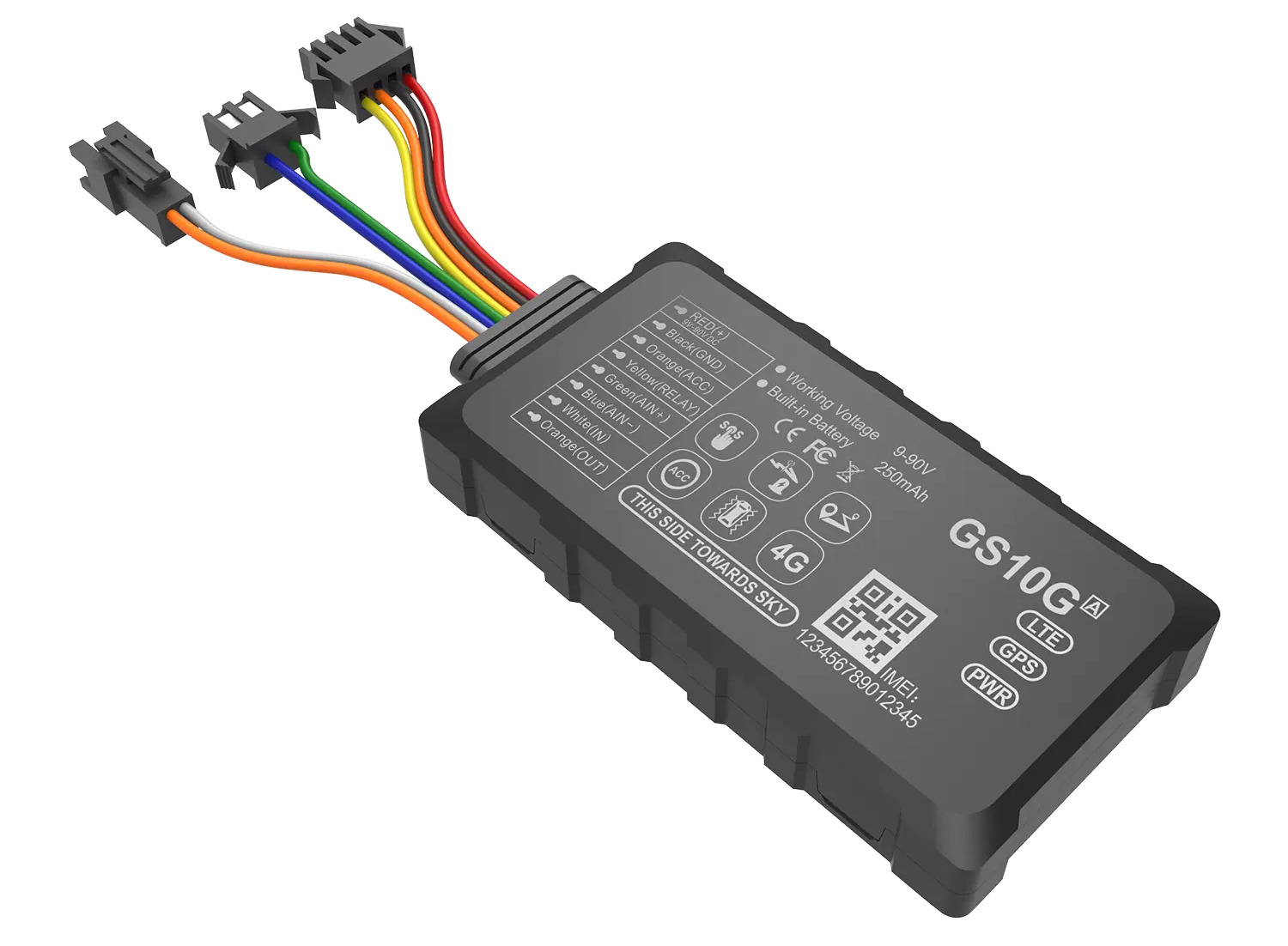
The WanWayTech GS10G is a GPS tracker platform frequently rebranded model name and sold in Australia under various names. Optus identifies this model as having "Reduced Coverage" due to missing support for 700MHz (Band 28), an important frequency used by Australian mobile networks.
Not all "4G" devices are equally suited to Australian networks.
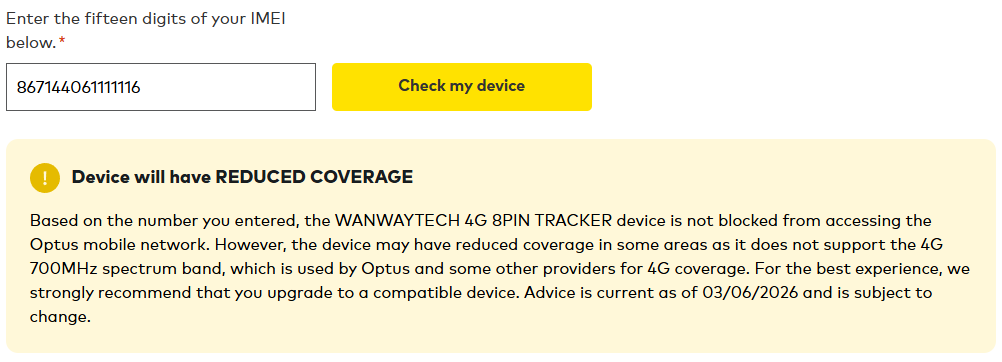
Optus IMEI lookup identifying the WanWayTech GS10G as having "Reduced Coverage" due to missing support for 700MHz (Band 28).
Screenshot captured June 2026.
Many GPS trackers sold in Australia are imported from overseas manufacturers and rebranded by local sellers. While some are excellent products, others may not be optimised for Australian networks or provide clear evidence of Australian compliance.
While some are excellent products, others may lack full Australian band support or clear evidence of compliance.
Before purchasing a tracker, it's worth asking:
- Does it fully support Australian mobile networks?
- Has the device been independently identified as having reduced coverage?
- Is there an Australian supplier standing behind the product?
- Does it display an RCM mark or provide compliance information?
What Is RCM Certification?

The Regulatory Compliance Mark (RCM) is Australia's official mark indicating that a product meets applicable requirements for:
- Electromagnetic compatibility (EMC)
- Radio communications standards
- Electrical safety requirements
In simple terms, it means the supplier has taken responsibility for ensuring the device complies with Australian regulations.
For devices that use cellular networks such as GPS trackers, compliance is particularly important.
“CE” Or “FCC” Does Not Automatically Mean Australian Compliant
One of the biggest misconceptions is that overseas compliance automatically means Australian compliance.
It does not.
A device being sold on Alibaba, Amazon or eBay with international markings does not necessarily mean it has been properly assessed for Australian regulatory requirements.
Who is Responsible for Compliance?
A common misconception is that the manufacturer is always responsible for compliance.
In reality, if an overseas manufacturer does not have an Australian presence, the importer or reseller often becomes the Responsible Supplier.
That means they may be required to:
- Hold compliance documentation
- Maintain test reports
- Ensure the product meets Australian standards
- Produce evidence if audited
This responsibility can carry significant cost and risk.
For cellular GPS tracking devices, achieving proper compliance can cost many thousands of dollars across testing, certification and regulatory compliance activities.
Importantly, these are not optional requirements.
This is one reason properly compliant GPS tracking products are often more expensive than ultra-cheap imported alternatives sold online.
When a GPS tracker is being sold at an unusually low price, it is reasonable to ask whether the importer has genuinely undertaken the compliance responsibilities required to legally supply the product in Australia.
Why Isn't Everything RCM Certified?
Many generic 4G GPS trackers can be imported into Australia for around $30 USD landed.
By comparison, obtaining and maintaining compliance documentation, testing, and certification can cost many thousands of dollars.
For low-cost products, the economics often don't stack up.
As a result, some imported devices may be sold without clear evidence of Australian compliance.
Can You Tell if a GPS Tracker is Compliant?
One thing buyers often notice is the absence of an RCM marking.
One thing buyers often notice is the absence of an RCM marking.
Under Australian regulations, compliant devices are generally expected to display the RCM on the product itself, although there are some exceptions where markings may appear on packaging or documentation instead.
If a product shows:
- No RCM marking
- No compliance information
- No supplier identification
…it can become difficult for buyers to independently verify whether the product meets Australian requirements.
It's important to note that the absence of an RCM logo alone does not automatically prove a device is non-compliant. However, it may be a useful indicator that further questions should be asked.
Cheap GPS Tracking Often Comes With Other Risks Too
Very cheap imported trackers are also commonly associated with:
- overseas hosted tracking platforms
- generic white label apps
- poor firmware support
- unreliable alerting
- limited security visibility
- no local platform ownership
In many cases, the same businesses selling ultra cheap hardware are also relying entirely on overseas tracking infrastructure.
Our Approach at CoreGPS
At CoreGPS, we believe customers deserve more than simply the cheapest possible tracking device sourced online.
We use quality European-manufactured GPS tracking hardware from Teltonika Telematics, one of the world’s largest telematics manufacturers.
Importantly, Teltonika maintains a local Australian presence and provides compliance documentation for their products, including devices carrying RCM certification.
Combined with this, we also operate our own tracking platform and infrastructure here in Australia.
Our servers are hosted in Australian data centres, and we focus on long-term reliability, local support, compliance and proper infrastructure ownership.
We are not trying to be the cheapest GPS tracker on the market.
We are built for customers who care about reliability, accountability, compliance and where their tracking data ultimately goes.